
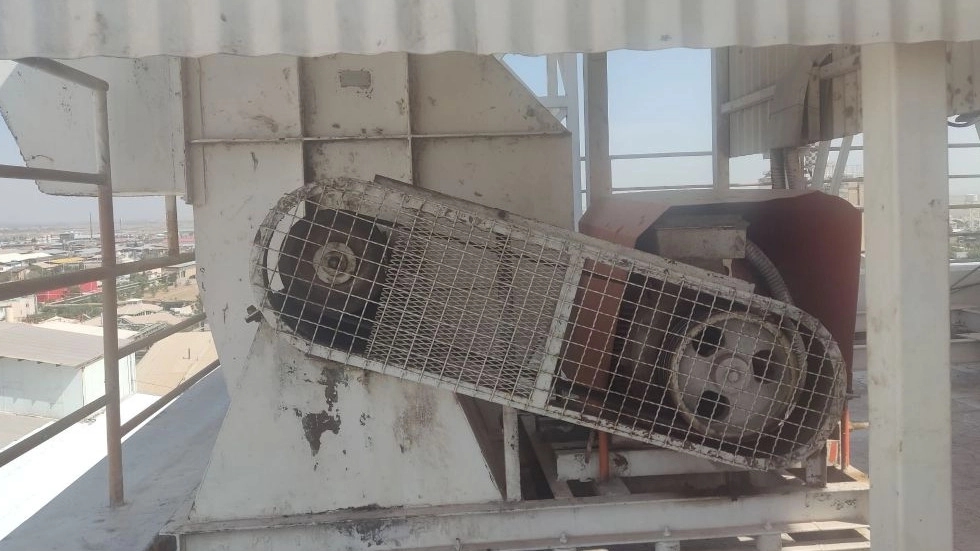
Industrial centrifugal fans are one of the important equipments in many factories, ventilation systems, steel, cement, petrochemical, power plants, food industries and production lines. The correct operation of these equipments has a direct impact on system efficiency, energy consumption, bearing and motor life, as well as equipment safety. One of the most important measures to prevent vibration and early fan failure is centrifugal fan balancing.
The higher the fan rotation speed, the smallest imbalance in the impeller can create a significant centrifugal force. This force is transferred to the shaft, bearings, coupling, motor and even the fan support structure. For this reason, centrifugal fan balancing is not only a simple repair operation, but also a part of the preventive maintenance program of rotating equipment.
In this article, we examine the concept of static and dynamic balance, the difference between these two methods, the causes of imbalance, the stages of balancing, the signs of the need for balance, and the importance of using an expert to balance centrifugal fans.
What is the balance of centrifugal fans?
Balancing of centrifugal fans is a set of measures that are performed to correct the improper distribution of mass in the rotating parts of the fan. In a balanced propeller, mass is distributed in such a way that unwanted forces and torques are minimized during rotation.
Ideally, the center of mass of the rotating assembly should be aligned with its axis of rotation. If these conditions do not exist, the centrifugal force caused by the imbalance will also increase with the increase in rotation speed.
For this reason, balancing of centrifugal fans should be done based on working speed, impeller dimensions, set weight, type of installation, working conditions and standards related to rotating equipment.
Imbalance may be caused by various reasons; For example, the accumulation of dust on the blades, corrosion, erosion, breakage of a part of the blade, improper repairs, asymmetric welding, deformation of the propeller or separation of correction weights.
The importance of balancing centrifugal fans in industries
Continuous use of an unbalanced fan can create significant costs for the industrial complex. Continuous vibration increases the load on bearings and other mechanical components and increases the possibility of failure in the long run.
One of the most important advantages of balancing centrifugal fans is the following:
- Reducing fan vibration
- Reducing the load on bearings
- Increasing the useful life of bearings and rolling bearings
- Reducing shaft depreciation
- Improving engine performance
- Reducing abnormal noise
- Increasing equipment reliability
- Reducing sudden stops of the production line
- Reducing costs Repairs
- Increasing the life of the propeller and rotating assembly
- Helping to reduce energy consumption in appropriate conditions
Therefore, centrifugal fan balancing can be considered one of the important measures to increase the reliability of rotating equipment.
What is the static balance of a centrifugal fan?
Static balance is one of the basic methods to check and correct propeller imbalance. In this method, the main focus is on the position of the center of mass relative to the axis of rotation.
If a propeller at rest tends to have its heavier part always in a certain position, it can be concluded that the mass distribution is not uniform. By using appropriate methods, it is possible to identify the heavy and light areas of the propeller and correct its condition by adding or removing mass.
However, static balance is not always sufficient for industrial fans with high rotational speeds. The reason is that a rotating assembly may be in good condition from a static point of view, but still have dynamic coupling or unbalance during rotation.
For this reason, in many industrial applications, the centrifugal fan balance should be selected according to the actual working conditions and the speed of the equipment.
Limitations of static balance
Static balancing can be useful for some propellers and simple rotating assemblies, but it has limitations.
In large, wide propellers or with two correction plates, mass distribution along the axis becomes very important. In such a situation, a purely static investigation cannot determine all the forces and moments caused by imbalance.
For this reason, when the fan works at high speed or significant vibration is observed at the installation site, a more specialized investigation and in many cases dynamic balancing of centrifugal fans becomes necessary.
What is the dynamic balance of a centrifugal fan?
Dynamic balance is a more accurate method to correct the imbalance of rotating equipment. In this method, the rotating assembly is checked and the information about the vibration amplitude and phase is used to determine the location and amount of correction.
In balancing dynamic centrifugal fans vibration sensors and special measuring equipment are usually used. The balancer device can provide information about the amount of imbalance and the required correction location.
One of the main advantages of dynamic balance is that, in addition to simple unbalance, it can also investigate the effect of improper mass distribution on different surfaces of the rotating assembly.
In large industrial fans where the impeller has a large weight and diameter, correct centrifugal fan balancing can play an important role in reducing vibration and preventing damage to mechanical components.
The difference between static and dynamic balance
The main difference between these two methods is in the way of checking the rotating set.
In static balance, the main focus is on the center of mass and the state of the assembly in a non-rotating state. But in dynamic balance, the rotating set is checked and the effect of forces created during rotation is also considered.
Simply speaking, static balance is applicable for simpler conditions, while for many industrial equipment, especially large and fast fans, dynamic centrifugal fan balance provides more complete information.
Choosing the right method should be done based on the type of fan, rotation speed, propeller weight, shaft structure, installation conditions and equipment sensitivity.
Why is the centrifugal fan out of balance?
Different factors can cause imbalance in the fan. Knowing these factors is very important for proper planning balance of centrifugal fans.
Accumulation of dust on the propeller
In industries where air or gas contains solid particles, there is a possibility of material accumulation on the blades. If this accumulation is not uniform, the mass distribution of the butterfly will change.
In this situation, the fan may be perfectly balanced at the time of installation, but it may vibrate after some time of operation.
Corrosion and erosion of blades
Corrosion can reduce part of the propeller mass and thus change the mass distribution. In fans used in corrosive environments, periodic inspection and balancing of centrifugal fans is more important.
Repairs and welding
Welding on the propeller, changing the blade or modifying parts of it, if done without considering the mass distribution, can cause imbalance.
Changing the shape of the butterfly
Mechanical impact, high temperature or stresses caused by working conditions may change the shape of the propeller. In this case, only balancing may not be enough and the mechanical condition of the propeller must be checked first.
Moving corrective weights
In some sets, corrective weights are used for balance. Separating or changing the position of these weights can increase the vibration.
Symptoms of the need to balance the centrifugal fan
Early problem detection can prevent costly breakdowns. Some of the most important symptoms are:
Abnormal increase in tremors
One of the most common signs of imbalance is increased vibration in the fan, bearing or chassis. If the amount of vibration increases over time, checking balance of centrifugal fans can be necessary.
Making an unnatural sound
A knocking, buzzing or unusual periodic sound can be a sign of a problem with the rotating assembly. Of course, any abnormal sound does not necessarily mean imbalance, and other factors such as bearing failure, mechanical laxity, and aerodynamic problems should also be investigated.
Increased bearing temperature
Imbalance can put additional load on the bearings and in some cases cause their temperature to increase.
Reducing the life of parts
Repetitive failures of bearings, couplings or shafts can be one of the signs of uncontrolled vibrations.
In such a situation, carrying out an expert investigation and if confirmed, centrifugal fan balancing can be a part of the corrective solution.
The steps of balancing centrifugal fans
The balancing process must be done carefully and based on the actual conditions of the equipment. The exact steps may vary depending on the type of fan, but usually include the following steps.
1. Preliminary examination of the fan
First, the appearance condition of the fan, propeller, shaft, bearings, coupling, bases and connections is checked.
Before starting the balancing of centrifugal fans, it should be ensured that the problem is not caused by looseness, cracks, bearing failure or mechanical deformation.
2. Vibration measurement
Using appropriate equipment, vibration is measured at different points. The amplitude of the vibration and, if necessary, its phase is recorded.
This information is important for diagnosing the type of problem and determining corrective measures.
3. Checking the speed of rotation
The actual speed of the fan should also be determined. Because the behavior of a rotating set can be different at different speeds.
4. Determining the place of correction
Based on the measurement data, the place and amount of correction is determined. Modification can be done by adding or removing a certain amount of mass.
5. Implementation of correction
After determining the place of correction, the operations related to adding or removing mass are performed. This step must be done carefully so that the new modification does not cause another problem.
6. Remeasurement
After correction, the fan is tested again. If excessive vibration remains, another modification may be required.
7. Record the results
Recording the balance and vibration results can be useful for comparing the condition of the fan in future periodic repairs.
Centrifugal fan balancing on site or workshop?
One of the common questions is whether it is better to take the fan blade to the workshop for balancing or to perform the operation at the installation site.
The answer to this question depends on the project conditions. In some cases, the impeller can be opened and transferred to the workshop for balance. But in large industrial fans, opening and moving the set may take a lot of time and cost.
In such a situation, balancing centrifugal fans on site can be a suitable option; Because the measurement and correction operations are performed according to the actual installation conditions.
The important advantage of on-site balance is that the actual condition of the assembly, including the shaft, bearing, coupling, base and installation conditions, is also taken into account in the troubleshooting process.
The importance of measuring equipment in the balance of centrifugal fans
The quality of the measuring equipment plays an important role in the accuracy of the operation. Balance and vibration analysis devices should be selected according to the type of equipment.
In a fundamental process of balancing centrifugal fans, only observing the amount of vibration is not enough. Information about the frequency, amplitude and phase of vibration can help diagnose the problem more accurately.
Also, the operator must have the ability to interpret the data; Because increased vibration is not always due to imbalance.
Does any vibration mean fan imbalance?
No. This point is very important in the process of balancing centrifugal fans.
Tremor can have different reasons; Including:
- Propeller imbalance
- Shaft misalignment
- Bearing failure
- Mechanical looseness
- Coupling problems
- Shaft bending
- Loose base bolts
- Intensification of vibration due to resonance
- Aerodynamic problems
- Contact of rotating and fixed parts
Therefore, the main cause of vibration should be determined before taking action for balance. Balancing an equipment whose main problem is bearing failure or misalignment does not necessarily solve the problem.
Centrifugal fan balancing services by Engineer Khalili in Tehran
For industrial complexes that seek to check and correct the vibration and imbalance of industrial fans, using expert services can make the process of troubleshooting and repair more targeted.
In Tehran, services related to the balance of the centrifugal fans of Engineer Khalili are provided, and you can see its introduction page to learn more about these services and business information:
In industrial projects, it is very important to choose a person or group that has experience working with rotating equipment and industrial fans; Because the correct diagnosis of the cause of the vibration, the selection of the balance method and the implementation of appropriate corrections are all effective in the final result.
The advantages of basic balancing of centrifugal fans
The correct balancing of centrifugal fans can have many benefits from the point of view of maintenance and operation.
The first advantage is the reduction of vibrations caused by imbalance. Reducing vibration can reduce the pressure on mechanical parts.
Another advantage is increasing the reliability of the equipment. In continuous production lines, a sudden stop of a fan may also affect the performance of other parts.
Also, vibration control can help reduce costs caused by premature replacement of parts. Of course, the amount of savings depends on the initial condition of the equipment, working conditions and the main cause of failure.
When should the balance of the centrifugal fan be done?
The appropriate time for centrifugal fan balancing depends on the operating conditions of the equipment. Some sets require balancing after repairing or replacing the impeller. In others, a gradual increase in vibration indicates the necessity of investigation.
In general, the following can be a good time to check:
- After overhauling the fan
- After replacing or repairing the impeller
- After welding on the impeller
- After observing an increase in vibration
- After replacing the bearing or shaft
- After major relocation of the fan
- In preventive maintenance programs
- After observing abnormal noise
- After changing the working conditions of the fan
Of course, the final decision should be made based on measuring and checking the actual condition of the equipment.
The role of balancing centrifugal fans in reducing the cost of repairs
The cost of repairing rotating equipment is not limited to the cost of the damaged part. Stoppage of the production line, manpower, repair time and possible damage to nearby equipment can also create significant costs.
For this reason, failure prevention is very important. Balance of centrifugal fans as one of the maintenance measures of rotating equipment can help to identify and correct one of the important factors of causing vibration.
Standard and quality in the balance of centrifugal fans
The final balance quality depends on various factors. The type of measuring device, the accuracy of the sensors, the installation method, the rotation speed, the quality of mass correction and the skill of the technician are all important.
In industrial projects, it is better to record the measurement results so that the condition of the equipment can be compared in different periods. This helps the maintenance team identify vibration changes faster.
Nor should you make a decision based solely on a number or a measurement. Analysis of the condition of the fan should be done according to operating conditions and maintenance records.
summary; Why is the balance of centrifugal fans important?
Industrial centrifugal fan is one of the rotating equipments whose correct operation depends on the health of the propeller, shaft, bearing, coupling and installation system. Any improper mass distribution in the rotating assembly can cause unwanted forces and increased vibration during rotation.
Balancing of centrifugal fans is a specialized solution to identify and correct imbalance. Static balance is used for simple conditions, but in many large and high-speed industrial fans, dynamic balance provides more detailed information about the condition of the rotating assembly.
On the other hand, any vibration does not mean imbalance. Before balancing, factors such as bearing damage, misalignment, slackness, shaft bending and structural problems should also be checked.
If you are looking for specialized services related to balancing of centrifugal fans in Tehran, you can check the introduction page of this collection to learn more about the services provided by Engineer Khalili:
Finally, performing regular vibration inspections and balancing of centrifugal fans as needed can be an important part of a rotating equipment preventive maintenance program and help increase reliability, reduce wear and tear, and prevent unwanted shutdowns.