
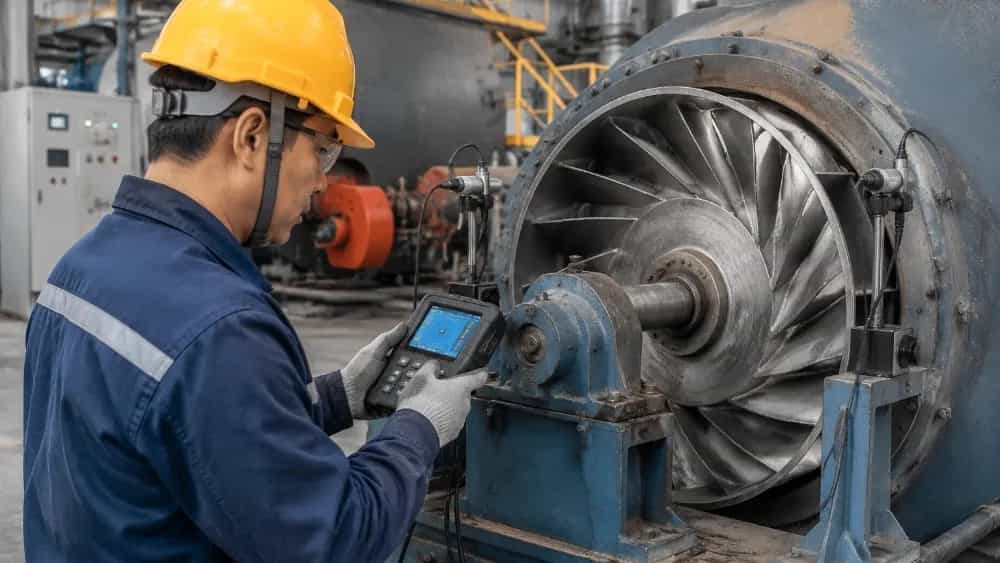
Balancing of boiler burner fan and engine room boiler is the process of adjusting the mass distribution of the centrifugal impeller so that destructive vibrations, mechanical stresses and abnormal sounds are minimized. In practice, it has been observed that the lack of accurate balance of this equipment, in addition to the severe drop in combustion efficiency, will cause serious damage to the bearings, shaft and body of the boiler. According to our technical reviews in industrial projects, the basic implementation of balance on site with laser and digital equipment significantly increases the life of the equipment.
Why the balance of burner fan and boiler is vitally important?
Centrifugal fans in the engine room are responsible for providing combustion air and transferring hot gases. With the passage of time, the settling of suspended particles, soot deposits and corrosion of the blades cause the center of gravity of the propeller to be disturbed. The centrifugal force caused by this imbalance creates a vibration frequency that is directly transmitted to the body of the boiler.
In the field investigations, it has been determined that the vibrations above the standard, in the first step, cause premature failure of the bearings, and in the next steps, it causes cracking of the fan body and welding connections of the torch. Therefore, the periodic balance is not a performance measure, but a technical necessity to maintain the safety of the engine room.
Signs of urgent need for centrifugal fan balance
Early recognition of signs of imbalance prevents heavy repair costs. The most important signs are:
- Obvious shaking and vibration in the fan body, ducts or boiler chassis
- Production of abnormal howling or humming sound at rated speed of the engine
- Loose connection pages of the chassis and electric motor bases
- Reduced combustion efficiency due to unbalanced air flow
Implementation steps of precise balancing of the fan in the place (In-situ Balancing)
To achieve the highest accuracy, there is no need to completely disassemble the system and transfer the impeller to the workshop. Using vibration analyzers and digital stroboscopes, our technicians perform the balancing operation in the following way:
1. Troubleshooting and primary measurement of vibrations
At this stage, the amount of vibration in the three horizontal, vertical and axial axes is measured and the error frequencies are separated to ensure that the problem is only due to unbalance and there is no mechanical slack or misalignment.
2. Weighing and mass correction of the propeller
Using mathematical techniques and specialized balancing software, the amount of correction weight and its exact installation angle are calculated. Then standard weights made of propeller material are installed on the blades by argon welding or safe screwing.
3. Final test and periodic monitoring
After the weights are installed, the device is turned on again and the vibrations are measured to ensure that the vibration is below the ISO critical limit.